The New Rules of War by Sean McFate
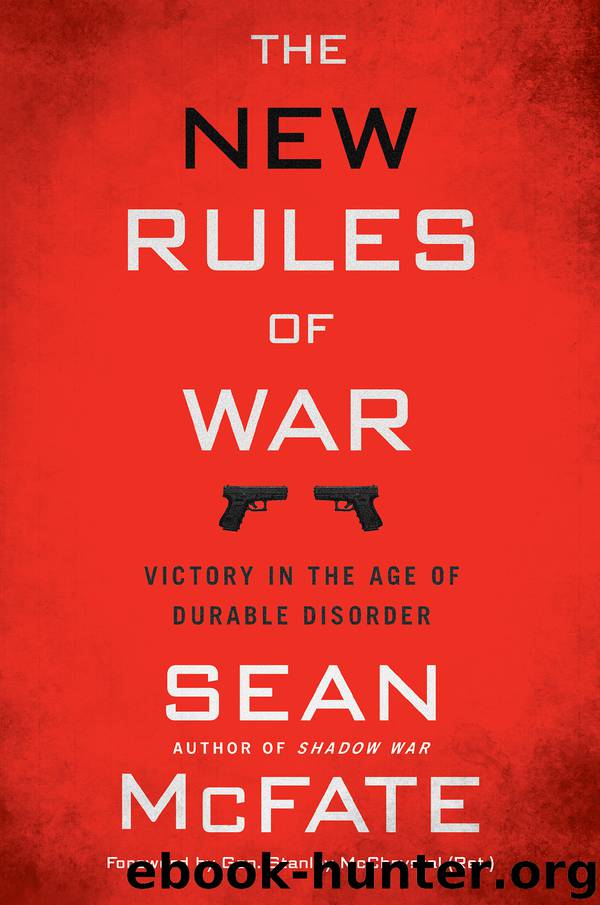
Author:Sean McFate
Language: eng
Format: epub, pdf
Publisher: HarperCollins
Published: 2019-01-21T16:00:00+00:00
Like all satire, it is funny because it’s half-true. Margaret Thatcher, then the real prime minister, was a fan of the show, and she said its “clearly-observed portrayal of what goes on in the corridors of power has given me hours of pure joy.”15 She even performed a Yes, Minister sketch. The series remains a classic of political satire and received numerous awards, including several BAFTAs.
It is possible that the United States has a deep state. Free-market democracy has been central to the republic since its founding, entwining political and business interests. Examples are numerous, from the undue political weight of the Vanderbilts, the Rockefellers, and other magnates during the Gilded Age, to today’s megacorporations, whose heavy lobbying activities receive the same legal treatment as a person exercising free speech. The American political system has always protected the nexus of corporate and political interests.
Concern that Wall Street trumps Main Street in America’s democracy is an old one. Tycoons and members of Congress dismiss it all as conspiratorial claptrap. However, the unaccountable power of big business and their dark money sloshing around Capitol Hill has long provoked citizen ire, from labor protests in the 1870s to the recent Occupy Wall Street protests. In the presidential election of 1896, the robber barons of the age—John D. Rockefeller, Andrew Carnegie, J. P. Morgan—bankrolled the Republican nominee, William McKinley, to defeat Democratic nominee William Jennings Bryan, and threatened their workers with lost jobs and closed down factories if Bryan won. McKinley was elected, but was assassinated five years later. The plutocrats met their match with the new president, Theodore Roosevelt, who was the first White House occupant to say it aloud: “Behind the ostensible government sits enthroned an invisible government, owing no allegiance and acknowledging no responsibility to the people.”16
The secret marriage of corporate and political agendas birthing an American deep state may shock some, but it shouldn’t. President Eisenhower famously warned the nation against the corrupting influence of what he termed the “military-industrial complex” in his farewell address. The military-industrial complex is a deep state alliance among the military, the arms industry that supplies it, and Congress, which oversees it. It’s an infinity loop fueled by corporate contributions to politicians, congressional approval for military spending, lobbying to support bureaucracies, and pliant government oversight of the industry.
Although the conflicts of interest are in plain sight, it does not stop retired generals and admirals from sitting on boards of “Beltway bandits”: corporations that line Washington’s ring highway and sell equipment to the Pentagon. These individuals help ease along lucrative military contracts. The result are more F-35s and aircraft carriers—the most expensive yet superfluous weapons in history—and the spending buffet of the Third Offset strategy. Ultimately, the deep state of the military-industrial complex encourages the militarization of foreign policy, forming a challenge to world peace.
A favorite tactic of deep state doubters is to deride the idea as fringe kooky, but Eisenhower’s credibility is beyond reproach. He was a two-term president, a retired five-star general, and a hero of World War II—he had unparalleled authority in the matter.
Download
This site does not store any files on its server. We only index and link to content provided by other sites. Please contact the content providers to delete copyright contents if any and email us, we'll remove relevant links or contents immediately.
Mindhunter: Inside the FBI's Elite Serial Crime Unit by John E. Douglas & Mark Olshaker(9270)
Wiseguy by Nicholas Pileggi(5720)
Room 212 by Kate Stewart(5078)
Hitman by Howie Carr(5045)
Secrecy World by Jake Bernstein(4709)
Killers of the Flower Moon: The Osage Murders and the Birth of the FBI by David Grann(4414)
Papillon (English) by Henri Charrière(4230)
Breaking Free by Rachel Jeffs(4198)
Killers of the Flower Moon by David Grann(4004)
Say Nothing by Patrick Radden Keefe(3946)
American Kingpin by Nick Bilton(3828)
The Secret Barrister by The Secret Barrister(3672)
Molly's Game: From Hollywood's Elite to Wall Street's Billionaire Boys Club, My High-Stakes Adventure in the World of Underground Poker by Molly Bloom(3515)
Mysteries by Colin Wilson(3429)
In Cold Blood by Truman Capote(3354)
Signature in the Cell: DNA and the Evidence for Intelligent Design by Stephen C. Meyer(3106)
I'll Be Gone in the Dark by Michelle McNamara(3058)
Rogue Trader by Leeson Nick(3020)
Bunk by Kevin Young(2974)
